PAICe Monitor
Tool-agnostic AI semiconductor manufacturing analytics software that optimizes quality and efficiency

Uniquely Handle Massive Data Streams – Delivering Faster, More Accurate Yield Gains
For semiconductor fab users, components manufacturers and materials suppliers, PAICe Monitor® allows you to achieve far beyond advanced process control. PAICe Monitor discovers sources of variance that are too complex for standard SPC charts and other linear methods. With PAICe Monitor, you have the power to immediately identify complex and non-linear multivariate relationships between process variables and target metrics, automatically generate analytics to monitor for complex process deviations, and prevent future occurrences. PAICe Monitor empowers your team to consistently increase yield and engineering productivity and reduce resource consumption.

Load and Visualize 16,000+ Traces in Seconds for Analysis
The Trace Viewer tab of PAICe Monitor enables rapid, intuitive visualization and analysis of tool trace data to support troubleshooting, anomaly detection, and process optimization. Embedded feature extraction requires no manual setup and automatically utilizes data from MES and logistics systems. Interactive metadata exploration allows users to hover and zoom for detailed insights. Intuitive troubleshooting enables engineers to identify and resolve tool issues within minutes.
Over 16,000 traces loaded in seconds
Tailored views for different analysis needs.
Quickly isolate periods of degradation or anomalies.
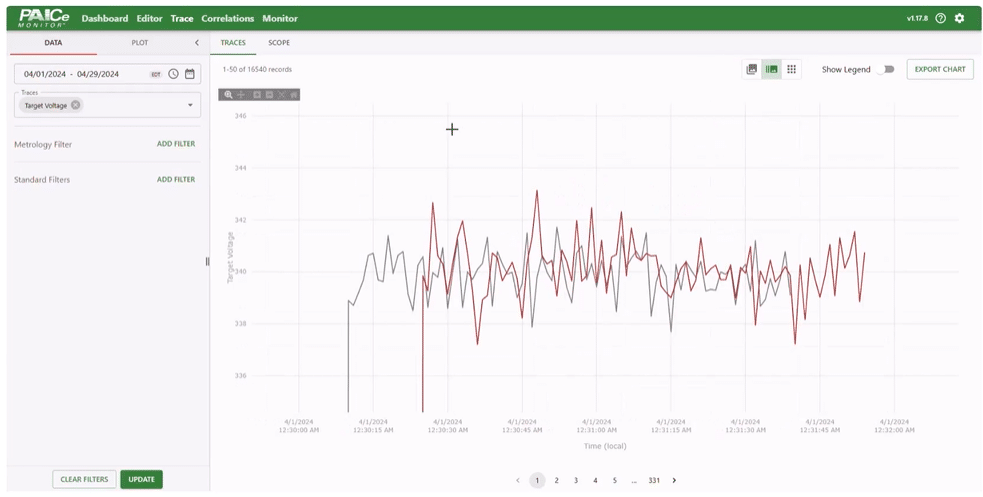
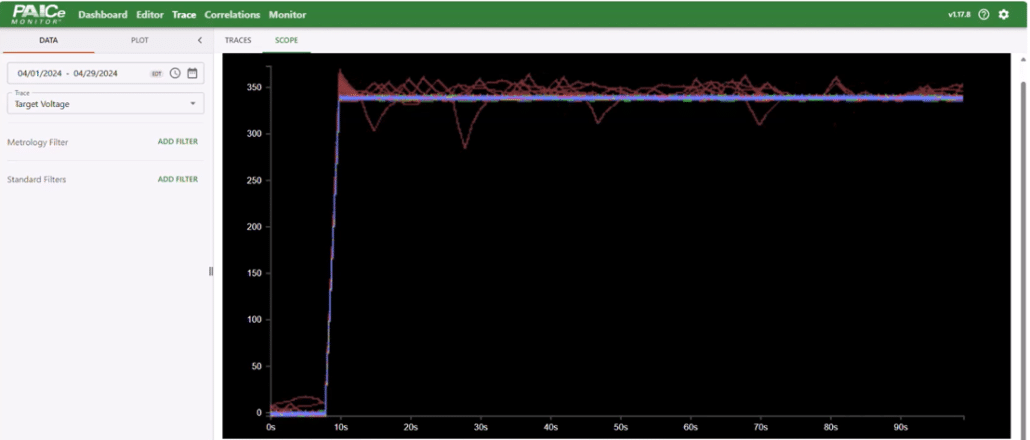
Users can filter trace data by days, weeks, or months. For example, April 1-29 selected demo.
Select specific parameters (e.g. target voltage). Filters include wafer ID, lot ID, recipe, and more. Advanced filtering based on product wafer responses (e.g., Rs mean thresholds).
Stacked Traces: Overlay all traces for comparison.
Timeline View: Sequence traces by time.
Grid View: Spot anomalies across lots at a glance.
Hovering reveals metadata (voltage, substrate ID, recipe, module, etc.).
Heat Map View enables time slicing and signal intensity modulation. Helps identify tool degradation or signal anomalies quickly. For example, detecting arcing/sagging in target voltage from a specific tool (e.g., “alouette”).
Adjusting intensity reveals data density and variability. Useful for pinpointing subtle or emerging issues.
Users can switch focus from tools to other metadata dimensions. Enables contextual analysis across different operational layers.
The Correlations tab in PAICe Monitor is designed to automate mathematical analysis to uncover root causes of process issues by analyzing trace data and logistics from manufacturing tools. Smart contextualization offers deep integration of trace and logistics data for richer insights. User-friendly visualization presents clear plots and distributions that are easy to interpret. Accelerator for new engineers helps less experienced users quickly understand key process drivers.
No manual setup required; intelligently selects best-fit models.
Topic-oriented storage enables rapid analysis.
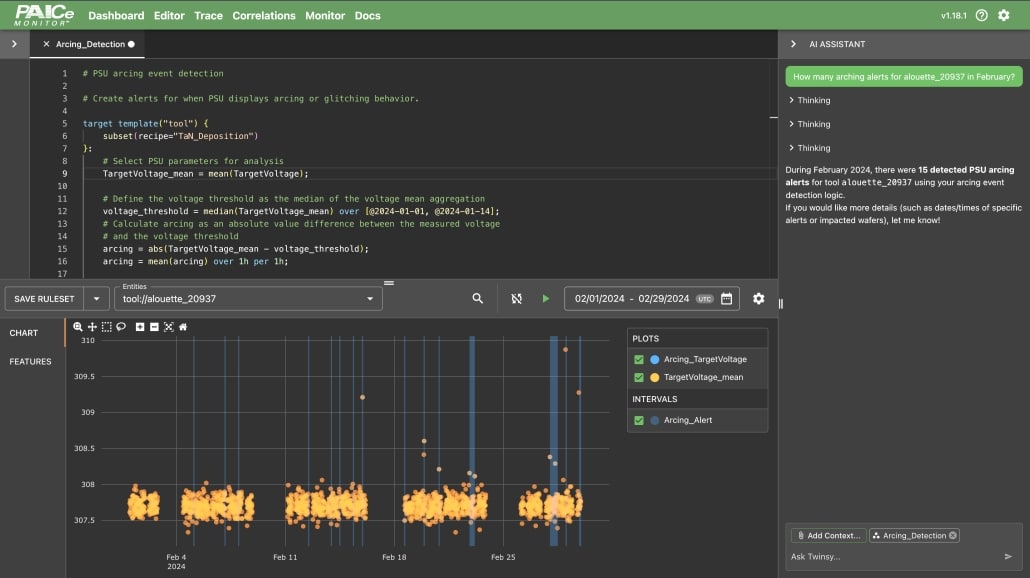
Dynamic rule sets for anomaly detection and process control.
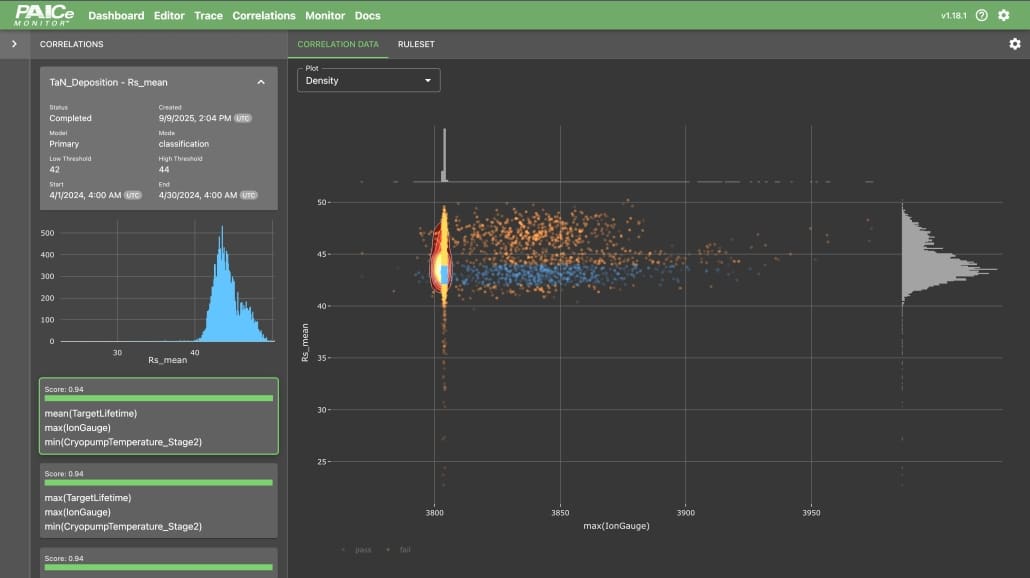
Users can filter by time range, lot recipes, and substrate IDs. Emulated data is used for demo purposes.
Metrics like Defects, Fail Percent, Sheet Resistance Mean, and Standard Deviation are used as correlation targets.
Primary Model: High-accuracy, tri-variate and smaller feature groups.
Secondary Model: Faster, less accurate.
Tertiary Model: Handless large datasets, limited to single/paired features.
Ingests raw trace data and logistics (MES, recipe steps, product IDs, etc.). Automatically generates summary statistics (mean, max, range) without manual setup.
Regression reveals relationships between parameters and outcomes. Classification identifies passing vs. failing runs and builds rule sets for anomaly detection.
Density plots, distribution charts, and predictability scores (e.g., R2 = 0.95). Enables intuitive understanding of parameter relationships.
Automatically generated rule sets help monitor and flag risky wafers. Can be saved and reused for ongoing analysis.
Uses topic-oriented storage for faster indexing and querying. More scalable than traditional column/object-oriented systems.

Complete our contact form.