PHYSICS, MACHINES AND DATA


Advanced Process Control In Semiconductor Manufacturing
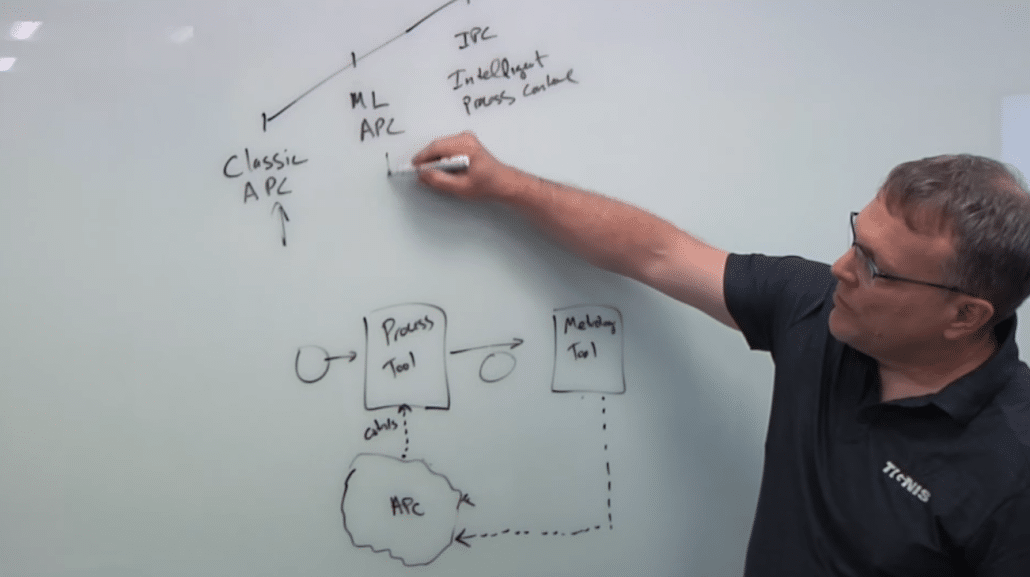
Advanced process control for semiconductor wafers is evolving in ways that can significantly improve yield and reduce scrap. As dimensions shrink, the need to improve manufacturing processes and reduce variability requires more precision. “Classic” APC was a step in the right direction, identifying problems in a process chamber, for example, and automating adjustments such as reducing electronic gases in a chamber or adjusting a wafer’s thickness due to critical dimension drift. That has been supplanted by machine learning-based APC, which adds virtual metrology to the picture. But there’s still a lot of data moving back and forth, which can result in multiple wafers being scrapped. Jon Herlocker, VP & General Manager of Tignis, A Cohu Analytics Solution, talks with Semiconductor Engineering about the next phase of APC, which includes intelligent process control, emulating the physics of an APC system, and optimizing it for multiple outcomes. This is part 5 of a 7-part series on AI in semiconductor manufacturing.





 Generative AI In Chip Manufacturing
This website stores cookies on your computer. These cookies are used to improve our website and provide more personalized services to you, both on this website and through other media. To find out more about the cookies we use, please see our Privacy Policy.
Accept All CookiesReview Cookie SettingsAccept Only Essential CookiesWe may request cookies to be set on your device. We use cookies to let us know when you visit our websites, how you interact with us, to enrich your user experience, and to customize your relationship with our website.
Click on the different category headings to find out more. You can also change some of your preferences. Note that blocking some types of cookies may impact your experience on our websites and the services we are able to offer.
These cookies are strictly necessary to provide you with services available through our website and to use some of its features.
Because these cookies are strictly necessary to deliver the website, refusing them will have impact how our site functions. You always can block or delete cookies by changing your browser settings and force blocking all cookies on this website. But this will always prompt you to accept/refuse cookies when revisiting our site.
We fully respect if you want to refuse cookies but to avoid asking you again and again kindly allow us to store a cookie for that. You are free to opt out any time or opt in for other cookies to get a better experience. If you refuse cookies we will remove all set cookies in our domain.
We provide you with a list of stored cookies on your computer in our domain so you can check what we stored. Due to security reasons we are not able to show or modify cookies from other domains. You can check these in your browser security settings.
These cookies collect information that is used either in aggregate form to help us understand how our website is being used or how effective our marketing campaigns are, or to help us customize our website and application for you in order to enhance your experience.
If you do not want that we track your visit to our site you can disable tracking in your browser here:
We also use different external services like Google Webfonts, Google Maps, and external Video providers. Since these providers may collect personal data like your IP address we allow you to block them here. Please be aware that this might heavily reduce the functionality and appearance of our site. Changes will take effect once you reload the page.
Google Webfont Settings:
Google Map Settings:
Google reCaptcha Settings:
Vimeo and Youtube video embeds:
The following cookies are also needed - You can choose if you want to allow them:
You can read about our cookies and privacy settings in detail on our Privacy Policy Page.
Privacy